
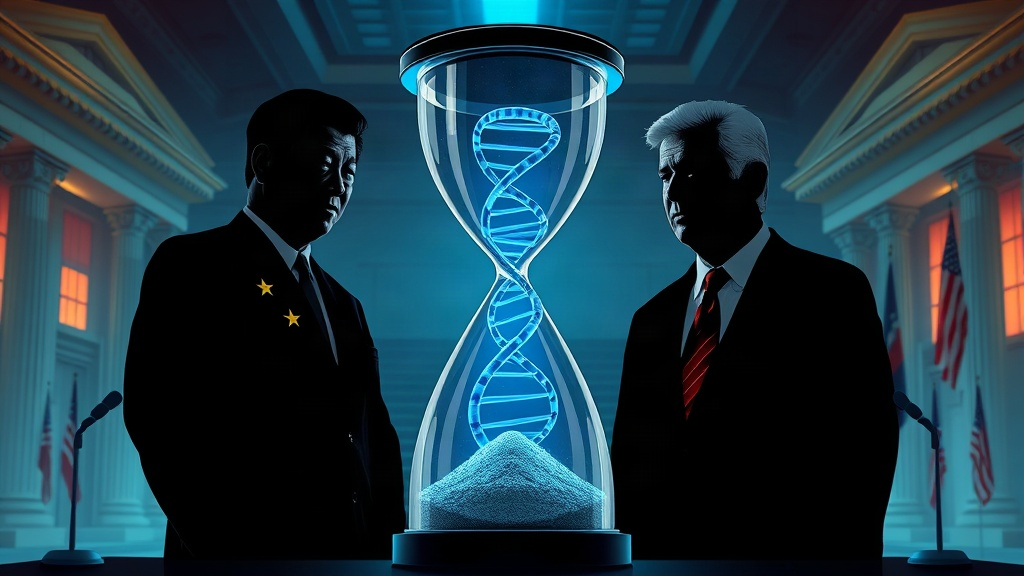
In an era where technology promises to solve humanity's oldest problem, the world's most powerful leaders are quietly investing in the ultimate luxury: cheating death. From Silicon Valley's life-extension startups to state-backed research programs, the quest for immortality has become a surprisingly political affair. And when figures like Xi Jinping and Donald Trump are rumored to be interested, the stakes extend far beyond personal vanity.
The Billionaire Obsession with Immortality
It's no secret that tech moguls like Elon Musk and Jeff Bezos have poured millions into anti-aging research. Musk has famously said he doesn't want to live forever, but his companies are working on brain-computer interfaces that could one day extend human consciousness. Bezos has backed Altos Labs, a startup dedicated to cellular rejuvenation. Meanwhile, Russian President Vladimir Putin has reportedly shown interest in life-extension technologies, even as his political longevity remains unchallenged.
But the allure of eternal life isn't just a Silicon Valley quirk. It reflects a deeper anxiety among the powerful: that their influence, wealth, and legacies are finite. For autocrats and populists alike, the idea of living to 150 or beyond offers a way to transcend the limitations of mortal politics.
Xi Jinping and the Chinese Dream of Longevity
In China, the pursuit of longevity has a long cultural history, from ancient Taoist alchemy to modern biotech. Under Xi Jinping, the state has poured resources into biomedical research, with a focus on extending healthy lifespans. The government's "Healthy China 2030" plan aims to raise average life expectancy to 79 by 2030, up from around 77 today. But beyond public health, there's a political subtext: a leader who can project vigor and long-term vision reinforces his own legitimacy.
Xi has consolidated power to a degree unseen since Mao Zedong, and in 2018 he removed presidential term limits, allowing him to rule indefinitely. While there's no evidence he's personally seeking immortality, the cult of personality surrounding him often emphasizes his vitality and vision for a "new era." In this context, the promise of extended life for the nation's elite could serve as a metaphor for the regime's own endurance.
Donald Trump and the Politics of Vitality
Donald Trump has long made health and stamina a central part of his public image. During his presidency, his doctors touted his "incredible genes" and predicted he would live well into his 90s. Trump himself has reportedly expressed interest in anti-aging treatments, though details are scarce. For Trump, the narrative of boundless energy serves a political purpose: it counters critics who question his age and fitness, and it projects strength to his base.
But Trump's interest in longevity also aligns with a broader American obsession with self-optimization. From biohacking to cryonics, the wealthy have long sought to extend their lives. What's new is the scale and the political dimension. When a former president and a Chinese leader both flirt with the idea of radically extended lifespans, it raises questions about who gets to live forever and who doesn't.
The Geopolitics of Anti-Aging Research
The race for longevity isn't just a scientific endeavor; it's a geopolitical one. Countries like China, the United States, and Russia are investing heavily in biotech, viewing it as a strategic asset. The nation that unlocks the secrets of aging could gain a massive economic and military advantage. Imagine a workforce that never retires, or soldiers who can fight longer. The implications for global power balances are staggering.
Moreover, the data generated by anti-aging research is incredibly valuable. Genetic information, health records, and biological samples are all part of the prize. This raises concerns about privacy and national security. If a foreign power gains access to the longevity secrets of a rival's elite, it could exploit them. The politics of immortality are, in many ways, the politics of information.
What Does It Mean for the Rest of Us?
For the average person, the prospect of leaders living to 150 might seem like science fiction. But it has real-world consequences. If life-extension technologies become available only to the wealthy, inequality will become literally eternal. The rich will live longer, accumulate more power, and entrench their advantages across generations. Social mobility, already stagnant in many countries, could grind to a halt.
There's also the question of resources. An ever-growing population of super-agers would strain healthcare systems, pension funds, and the environment. Who will pay for the longevity of the elite? Likely, the rest of us. And as leaders live longer, the possibility of political renewal diminishes. Gerontocracy, already a concern in many democracies, could become the norm.
The Ethics of Eternal Life
Philosophers and ethicists have long debated whether immortality is desirable. Some argue that death gives life meaning; without it, we might lose urgency and creativity. Others point out that extending life without extending health would lead to prolonged suffering. Then there's the question of justice: if we can cure aging, shouldn't we make it available to all? The current trajectory suggests otherwise.
Religious and cultural traditions also weigh in. In China, Taoist notions of immortality are about harmony with nature, not domination over it. In the West, Judeo-Christian views often see immortality as the domain of the divine. The secular quest for eternal life, driven by tech and politics, challenges these deep-seated beliefs.
Conclusion: The New Frontier of Power
The strange politics of living forever is not just about vanity or fear. It's about power: who has it, who wants it, and how long they can keep it. As Xi Jinping, Donald Trump, and their peers eye the horizon of extended life, they are reshaping the very meaning of leadership. For the rest of us, the question is not whether we want to live forever, but whether we want to live in a world where only the powerful do.
Frequently Asked Questions
Are Xi Jinping and Donald Trump actually trying to live forever?
There is no concrete evidence that either leader is personally pursuing life-extension treatments. However, both have cultivated images of vitality and long-term vision, and their countries invest in anti-aging research. The interest is more political and symbolic than proven personal practice.
How does anti-aging research affect global politics?
It creates a new arena of competition. Nations that develop life-extension technologies could gain economic and military advantages, and the data from such research is highly valuable. It also raises ethical and security concerns about who controls these breakthroughs.
What are the risks of life-extension technologies for society?
If only the wealthy can afford them, inequality will deepen, and power could become hereditary in a literal sense. It may also strain resources and reduce political turnover, leading to entrenched gerontocracies.
Is immortality ethical?
Opinions vary. Some argue it would rob life of meaning and exacerbate social problems. Others see it as a natural extension of humanity's quest to overcome limitations. The key debate is about equitable access and the potential consequences for society.