
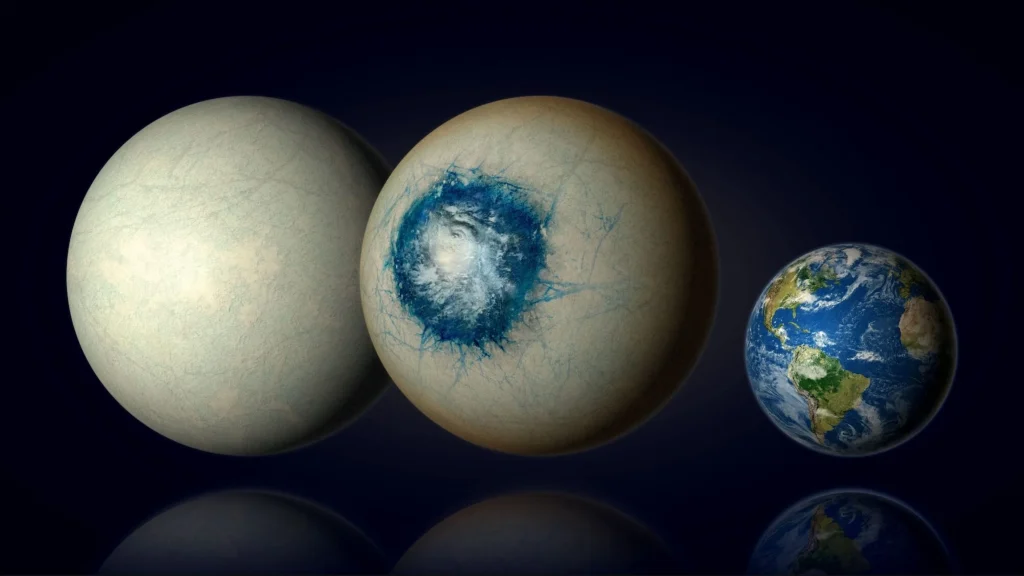
The groundbreaking detection of biosignatures on remote world K2-18b has sent shockwaves through the scientific community, providing the most compelling evidence of potential life beyond our solar system. Using the state-of-the-art James Webb Space Telescope (JWST), international researchers analyzed light filtering through the exoplanet’s atmosphere, located 124 light-years away in the constellation Leo. The observation revealed the distinct chemical fingerprints of carbon-bearing molecules and biological byproducts, offering humanity its first observational glimpse into the chemistry of an inhabited alien environment.
Table of Contents
The JWST Discovery: What Atmospheric Spectroscopy Tells Us
For decades, astronomers have searched for planets that could mimic Earth’s perfect biological conditions. However, the latest spectroscopic scan focusing on habitable-zone exoplanets has yielded data indicating biosignatures on remote world structures, altering our understanding of planetary habitability.
The JWST has successfully detected dimethyl sulfide (DMS) and dimethyl disulfide (DMDS) on K2-18b. On Earth, these specific sulfur-bearing gases are only produced by living organisms, primarily marine phytoplankton and microbial life, making their presence a monumental astronomical clue.
Understanding the Chemistry of K2-18b as a Hycean Planet
By focusing its powerful infrared spectrograph on the constellation Leo, the observatory analyzed light filtering through the planet’s atmosphere to identify potential biosignatures on remote world environments. K2-18b is classified as a “Hycean” world—a theoretical class of planet possessing a hydrogen-rich atmosphere and vast liquid-water oceans.
In addition to the complex sulfides, the telescope’s data confirmed high levels of carbon dioxide and methane, while showing a severe depletion of ammonia. This chemical configuration strongly supports the presence of a global ocean hidden beneath a thick hydrogen envelope, establishing a highly viable environment for life.
Spectroscopic Analysis: Earth-Like vs. Hycean Atmospheres
Evaluating the chemical composition of these biosignatures on remote world candidates compared to sterile, gas-rich sub-Neptunes reveals crucial molecular anomalies. The comparison below illustrates the unique atmospheric indicators captured by JWST.
| Atmospheric Indicator | Standard Mini-Neptune (Sterile) | Hycean World (K2-18b Data) |
|---|---|---|
| Methane & Carbon Dioxide Ratio | Low / Trace Levels | Dominant (Indicates Ocean Chemistry) |
| Confirmed Biosignatures on Remote World | None Detected | Dimethyl Sulfide (DMS) & DMDS |
| Ammonia Presence | High (Rich in toxic gas) | Near-Zero (Depleted by oceans) |
| Liquid Surface Layer | Barren gas / Ice-rock layers | Global Liquid Water Ocean |
What the Experts Say: Observational Astrobiology and the 5-Sigma Threshold
Even with a 99.7% statistical confidence level, identifying biosignatures on remote world atmospheres remains a highly debated topic among astrobiologists. While the current three-sigma detection is the strongest hint of alien life yet, scientists urge cautious optimism.
“We have entered the era of observational astrobiology. While the presence of DMS on K2-18b is incredibly exciting, we need additional hours of follow-up observation with JWST to reach the definitive five-sigma significance required to claim an absolute discovery.”
To confirm that these molecules are not produced by an unknown abiotic geological process, researchers are refining their physical models. The telescope will continue dedicating observation windows to K2-18b, slowly unveiling the ultimate answer to whether we are alone in the cosmos.
Frequently Asked Questions
Did the James Webb Telescope confirm biosignatures on remote world K2-18b?
JWST detected dimethyl sulfide (DMS) and dimethyl disulfide (DMDS) at a 99.7% confidence level. While these are strong biological indicators, further observations are required to fully confirm life.
What organic compounds represent typical biosignatures on remote world environments?
Gases such as oxygen, ozone, methane, carbon dioxide, and specifically complex organosulfurs like DMS and DMDS serve as primary biosignatures because they are closely tied to biological activity on Earth.
How far away is the exoplanet K2-18b?
K2-18b is located approximately 124 light-years away from Earth in the constellation of Leo, orbiting a cool red dwarf star called K2-18 once every 33 days.