
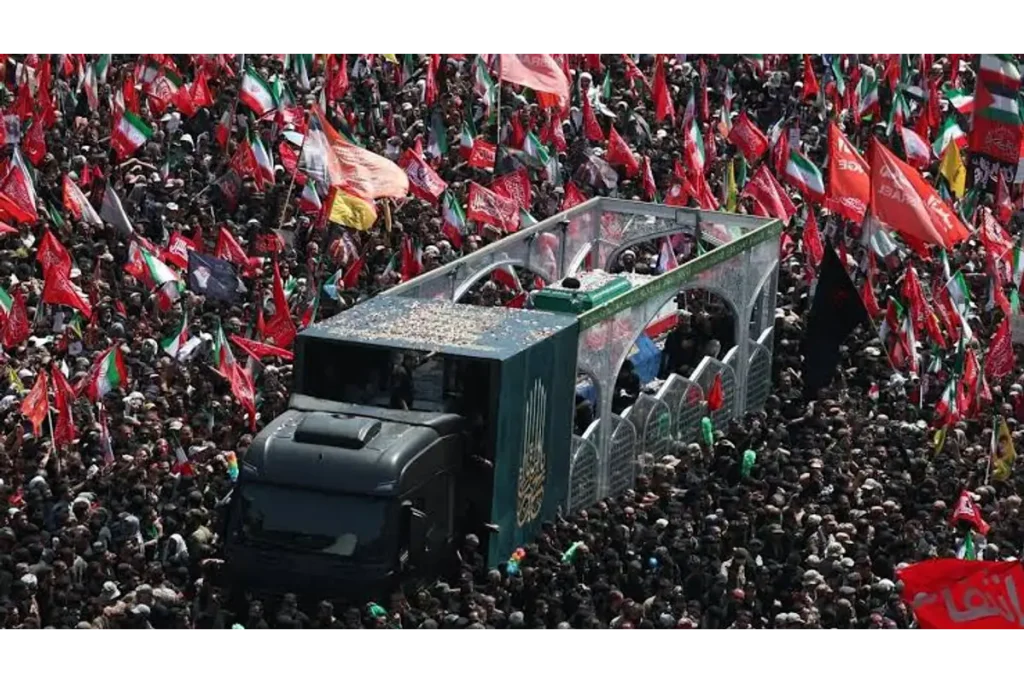
Ali Khamenei funeral procession has drawn millions of mourners to the streets of Tehran, plunging Iran into national mourning and driving geopolitical tensions in the Middle East to an all-time high. Following his death in a joint US-Israeli airstrike, the massive state funeral for the former Supreme Leader is serving as a major domestic and regional display of power.
Table of Contents
- 1. Millions Gather in Anger Across Tehran Streets
- 2. Route and 6-Day Schedule of the Ali Khamenei Funeral Procession
- 3. Power Projection and Middle East Security Dynamics
- 4. Succession Race and the Future of Iranian Politics
- Comparison of Iran’s Largest Historic Funerals
- Frequently Asked Questions (FAQ)
1. Millions Gather in Anger Across Tehran Streets
The Islamic Republic of Iran is bidding its final farewell to its former Supreme Leader, who was killed in a joint US-Israeli airstrike on his residence in Tehran back in February.
Millions of black-clad mourners filled the streets of the capital, carrying red flags of revenge and holding portraits of the late leader, creating one of the largest public gatherings in the country’s modern history.
“You stood like a mountain for Iran until your final breath. Now, the people of this sacred land stand united in seeking justice for your martyrdom.”
— Official Eulogy at Tehran Musalla Mosque
Local state media reported that this massive Ali Khamenei funeral procession is aimed at demonstrating public solidarity and the survival of the regime’s ideological base. Authorities claim the turnout is among the highest witnessed since the 1979 Islamic Revolution.
2. Route and 6-Day Schedule of the Ali Khamenei Funeral Procession
Organized under the strict planning of the government committee led by First Vice President Mohammad Reza Aref, the procession is being conducted with extreme logistical care.
Starting in Tehran on Saturday and concluding in Mashhad on Thursday, the Ali Khamenei funeral procession has been strategically extended to include holy Shiite cities in neighboring Iraq.
The funeral convoy’s itinerary is scheduled as follows:
- Tehran (Saturday – Monday): State ceremonies, reception of foreign dignitaries, and massive public rallies in the capital.
- Qom (Tuesday): Public gatherings and religious services in Iran’s prominent theological center.
- Najaf & Karbala (Wednesday): The body will be transferred to Iraq for major religious processions at the holy shrines of Imam Ali and Imam Hussein.
- Mashhad (Thursday): Final burial rites will take place at the Imam Reza Shrine in Khamenei’s hometown.
Security sources confirm that maximum alert protocols are active nationwide to prevent any disruptions during this complex multi-city movement.
3. Power Projection and Middle East Security Dynamics
Following a massive military shock, Tehran is leveraging this event to demonstrate that its ruling establishment remains highly resilient.
Serving as a major regional power projection, the Ali Khamenei funeral procession highlights the regime’s deep ties with regional allies despite the ongoing military standoff.
General Esmail Qaani, commander of the IRGC Quds Force, praised Iraq’s assistance in securing the cross-border arrangements, noting that the axis of resistance remains unshaken. Although backchannel diplomatic negotiations with Western powers continue, the slogans of retaliation heard across the crowd signal high geopolitical volatility.
4. Succession Race and the Future of Iranian Politics
While the constitutional process for selecting a new Supreme Leader has officially commenced, deep political uncertainties continue to hover over Tehran.
Amid succession debates, the Ali Khamenei funeral procession provides the establishment with a crucial social platform to project unity and legitimize the transition.
Mojtaba Khamenei, widely tipped as the leading candidate to succeed his father, has remained out of the public eye since February, fueling domestic speculation. Analysts predict that after the Ali Khamenei funeral procession, the Assembly of Experts will convene to formally announce the final decision regarding the country’s next ruler.
Comparison of Iran’s Largest Historic Funerals
The following table compares the scale, duration, and key political messages of the three largest state funerals in Iran’s modern history:
| Leader / Figure | Year | Duration | Estimated Turnout | Primary Political Message |
|---|---|---|---|---|
| Ayatollah Khomeini | 1989 | – | ~10 Million | Loyalty to the Islamic Revolution and regime survival. |
| Qasem Soleimani | 2020 | 4 Days | ~6 Million | Anti-US mobilization and unity of the Axis of Resistance. |
| Ali Khamenei | 2026 | 6 Days | Millions | Resilience against external strikes and intent of retaliation. |
Mass public attendance has historically served as a vital tool for the regime to claim domestic legitimacy during times of severe external threat.
Frequently Asked Questions (FAQ)
Q1: When did Ali Khamenei die, and why is the Ali Khamenei funeral procession taking place now?
Answer: Iranian Supreme Leader Ali Khamenei was killed in a joint US-Israeli airstrike on February 28, 2026. Ongoing military conflicts, extensive logistical planning, and high-level diplomatic discussions delayed the massive Ali Khamenei funeral procession until early July 2026.
Q2: Which cities and countries are included in the funeral route?
Answer: The 6-day procession covers the cities of Tehran and Qom in Iran, before extending to the holy Shiite cities of Najaf and Karbala in Iraq. The procession will culminate with the final burial in Khamenei’s hometown of Mashhad.
Q3: Who is expected to succeed Ali Khamenei?
Answer: According to Iran’s constitution, the Assembly of Experts will select the next Supreme Leader. Mojtaba Khamenei, the late leader’s son, is widely considered the frontrunner, though no official announcement has been made yet.